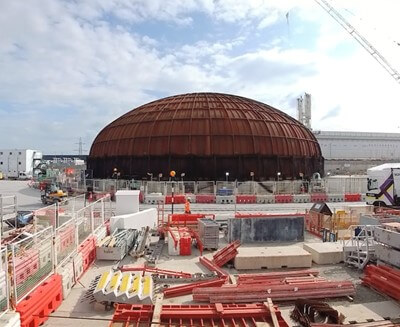
Specialist advice for Hinkley Point C new nuclear development
Supporting discharge of marine licence conditions and Development Consent Order requirements
Learn more

Dungeness B Nuclear Power Station, on the coast of Kent, is in its decommissioning phase. As part of the defueling process, the main cooling water pumps are planned to be switched off, which will significantly reduce the dilution of trade effluents (liquid waste) prior to discharge into the marine environment.
Operator EDF Energy commissioned ABPmer to produce Environmental Risk Assessments to determine the potential environmental impact of the change in effluent dilution. Our initial Risk Assessment focussed on total residual oxidant (TRO), a measure of the residual biocide concentration within the cooling water, while the second considered TRO alongside other primary waste streams.
To inform the initial Risk Assessment, we:
Reviewed data and associated reports relating to the TRO
Conducted a literature review to provide context to the results and outline environmental threshold values
Reviewed the expected dilution rates and extents of the mixing zones (where the TRO meets the ambient water) based on previous studies and the creation of a 3D near to field model
Assessed the risk to the environment based on the predicted discharge concentrations and mixing zone
Our assessment considered the size of the predicted mixing zone for TRO concentration against Environmental Quality Standards (EQS) values as per the Water Framework Directive.
To inform the Risk Assessment for the remaining waste streams:
The concentration, release regime and behaviour of the parameters were examined
Concentrations within the nearfield mixing zone were examined, based on dilutions derived in the initial Risk Assessment for TRO, and behaviour of parameter in the marine environment
Resultant concentrations and release regimes were reviewed in relation to Environmental standards and environmental harm to the environment
Potential impacts were discussed, and the extent of any potential environmental quality standard (EQS) exceedance identified
It was concluded that, due to dispersion characteristics, the small volumes and short duration of the discharges, and the infrequency of discharge, the environmental risks of the waste streams was negligible.
Image courtesy EDF Energy
ABPmer’s planning and consents specialists regularly prepare environmental statements and support developers through the minefield of marine consents.
Discover what our consents and licensing services can do for you.




Supporting discharge of marine licence conditions and Development Consent Order requirements
Learn more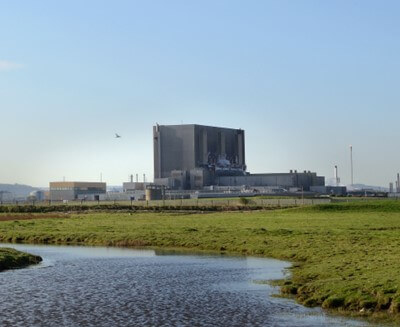
Managing the marine licence application process for the coolling water infrastructure, and producing all required information and documentation
Learn more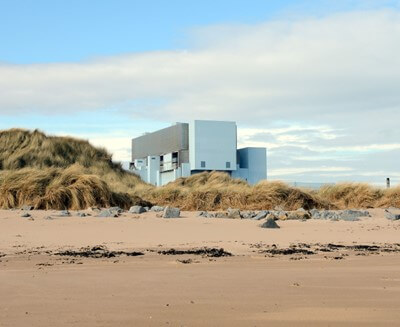
Supporting a permit variation for a change in discharged coolant water oxidisation
Learn more