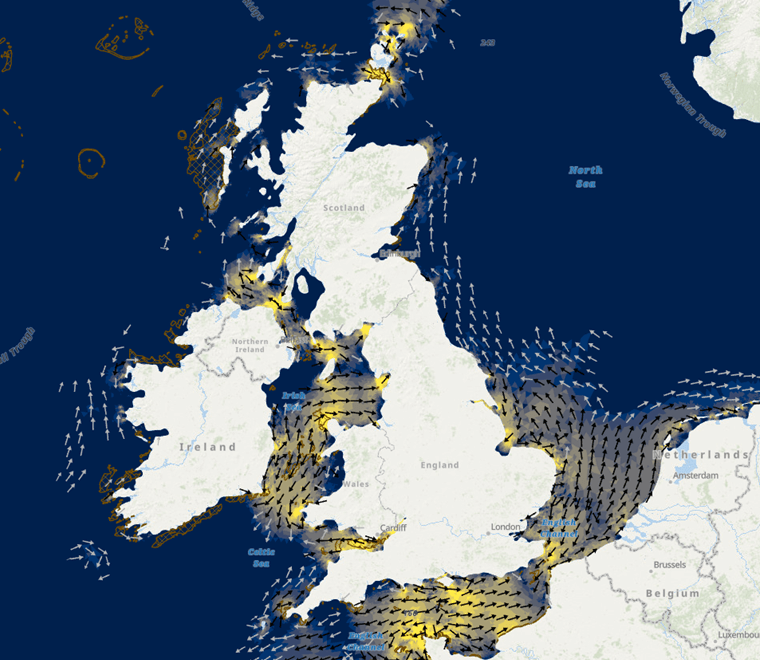
Mapping UK marine energy resources: Renewables Atlas update
Updates to the UK Atlas of Marine Renewable Energy support decision-making for renewable energy developments throughout UK waters. Learn more.
Read article

Metocean | Ports,Harbours,Marinas
We are developing detailed hydrodynamic models to support the teams competing in the 2025 season of the Rolex SailGP Championship
SailGP is an global racing league, featuring 12 teams going head-to-head on high performance F50 foiling catamarans in short, intense races through 12 events across the calendar.
The 2025 season of the Championship is well underway; the world class athletes have competed in Dubai, Auckland, Sydney and Los Angeles, with the seventh event, the Emirates Great Britain Sail Grand Prix, taking place this weekend (19 – 20 July).
ABPmer is the official Tidal Modelling supplier for SailGP. We are providing race-day current data at 10-minute intervals for key 2025 season races where tides are the primary driver of surface currents, including Auckland, New York, Andalucía – Cádiz, San Francisco, and this weekend’s race in Portsmouth.
Our modelling specialists are creating high-resolution hydrodynamic (water motion) numerical models for the teams to provide date and time specific maps of current speed and direction across the race areas. The numerical models are developed using a ‘flexible mesh’ approach to allow the accurate representation of locally important bathymetric (water depth) features, while maintaining computational efficiency.
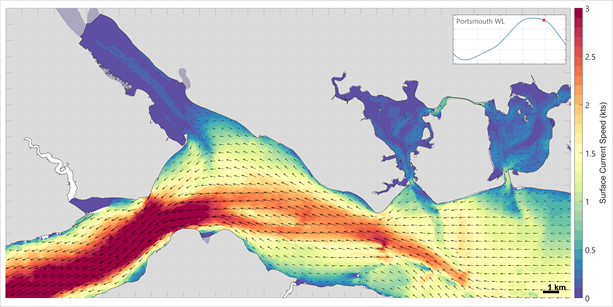
Example tidal current data around the Portsmouth race area
With the SailGP teams racing the cutting-edge F50 wingsailed catamarans to electrifying speeds approaching 100 km/h, tidal current information is a key data-feed used to optimise performance and inform strategy on race days.
As part of the Associated British Ports Group, we will be joining ABP Southampton in supporting this weekend’s race. The local Technical Team will be storing and launching 10 of the catamarans ahead of each day’s racing.
ABPmer is a recognised leader in offshore, coastal and estuarine numerical modelling. Our sophisticated numerical models regularly support estuarine, coastal and offshore projects, including feasibility and design studies, impact assessments and operational planning.
Main photo courtesy SailGP
This article was first published in July 2021 and has since been updated




Updates to the UK Atlas of Marine Renewable Energy support decision-making for renewable energy developments throughout UK waters. Learn more.
Read article
Scottish Government appointed ABPmer to support the revision of its Sectoral Marine Plan for Offshore Wind Energy, now at consultation. Learn more
Read article
What are the risks of adverse weather to the design, installation and maintenance of floating offshore wind farms, and how can they be managed?
Read article