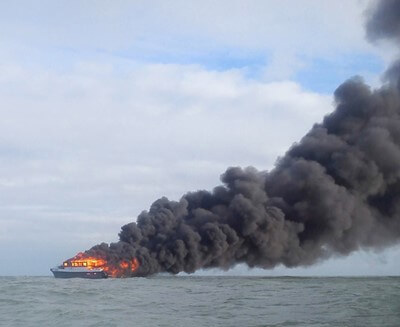
Marine Accident Investigation training - ABPmer
Discover the core knowledge needed to carry out accident and incident investigation and reporting.
Tell me More

Maritime | Ports,Harbours,Marinas
How can harbours, ports, terminals, marinas or marine facilities, ensure their approach to risk management delivers operational safety and efficiency?
The October 2023 training course has now passed. Sign up to be notified about future course dates, or enquire about bespoke courses at your location.
Under the Ports & Marine Facilities Safety Code (PMSC), it is recommended that harbours, ports, terminals, marinas and other marine facilities operate under a Marine Safety Management System (MSMS) to ensure risks are tolerable and reduced to a point termed ‘As Low As Reasonably Practicable’ (the ALARP principle).
Marine risk management is an integral part of any MSMS, and underpins the guiding ethos of the PMSC.
Robust risk management helps deliver safe and efficient operation, fulfilling the requirements of the PMSC and promoting industry best practice.
But how can organisations ensure their risk management approach is sufficiently robust to achieve this level of safety and efficiency?
On this page
The first step to delivering a robust risk management approach is to understand the elements of marine risk assessments, and how to properly record and review them.
PMSC-compliant risk assessments comprise the following:
Hazards (hazard scenarios, outcome categories)
Causes
Risk evaluation (consequence, frequency)
Controls (current, future)
Record and review of findings
The PMSC 'A guide to good practice on port and marine facilities', the Health and Safety Executive (HSE) and the International Maritime Organization (IMO) each has distinct definitions of each of these elements, that helps organisations understand what is required.
As well as understanding the makeup of a Marine Risk Assessment, it is important to know how to properly categorise marine hazards.
There are various hazard category lists available to organisations, including:
Offshore Renewable Energy Installations (OREI) navigation risk guidance
Marine Accident Investigation Brand (MAIB) casualty event definitions
Insurance definitions
Categorising marine hazards allows organisations to report incident and track trends. Common categories allow trends to be compared with other port operators.
Once you understand marine risk assessments and how to categorise hazards within them, it is important to know which assessment method to use.
There are various methods of marine risk assessment, including:
Qualitative and quantitative risk assessments
‘Bow tie’ risk assessments
The PEAR model
Cost-benefit analysis
The FSA method
Knowing what these methods entail, and which method is suitable for the category of risk, will help you effectively plan your risk assessment.
An effective marine risk assessment will accurately identify possible causes of risk to inform appropriate risk controls.
There are many possible causes of marine risk. Having a thorough knowledge of these causes will help you identify the right controls that should be put in place for a given risk.
Equally, there are types of risk controls that reduce the consequence of a hazard. Understanding these different types, and how to properly evaluate them, will support a robust risk assessment.
The final stage of a risk assessment is to evaluate the risk, then review it.
There are several factors involved in risk evaluation, including:
Risk receptors
Criteria of receptors
Hazard consequence and frequency
Understanding these factors, and how they can be used in risk calculations, will support a quality evaluation ready for review.
An effective risk review will be based on the ALARP principle. Guidance from The Health and Safety Executive and the PMSC identifies that the Duty Holder is responsible for judging whether ALARP has been reached, which requires a clear understanding of the principle and its implications.
Before reviewing your organisation’s risk management approach, you should ask yourself the following questions:
Do I understand the parts of a marine risk assessment, and how to record and review them?
Do I know how to categorise marine hazards, using agreed definitions consistently?
Am I able to apply the appropriate risk assessment methods, causes and controls?
Do I know how to properly evaluate and review risk?
If you are new to marine risk assessments or risk management, these questions can be intimidating. But being able to answer ‘yes’ to all of them will ensure you can deliver robust risk management that helps deliver safe and efficient operation, fulfilling the requirements of the PMSC and promoting industry best practice.
So how can individuals gain the required knowledge to support robust risk management at their marine facilities?
ABPmer’s Marine Risk Management Training provides a systematic framework for the categorisation and control of marine risk.
Our experienced maritime specialists provide examples from across the industry, to give context to risk control mechanisms and their application to different forms of marine facility.
Through the course, ports, harbours and marine facilities will be able to understand the risks under their responsibility, how to control them and mitigate to the ALARP principle.
By the end of the course, attendees will understand:
How to identify and categorise marine hazards
The potential impact of marine hazards
How to determine and categorise risk
The application of mitigation
The control of marine risks and use of a risk register
How to set an organisation's tolerability threshold
Risk assessment tools and the review process
Want to learn more about the Marine Risk Management Training course? Contact us or visit our dedicated training page. If you are ready to join our next course, click below to book.
Start date | Days | Price |
|
|---|---|---|---|
31 October 2023 | 1 | £240 | Book → |
Can't make the next course date? Sign up to be notified about future courses:
Your details will only be used to contact you about the Marine Risk Management Training course. They will not be passed on to any third party or used in any other way without your express permission.
ABPmer’s maritime risk specialists are dedicated to helping ports and other marine operators meet the requirements of the Port Marine Safety Code, regularly developing and auditing Safety Management Systems.
Our training courses for port and marine professionals are delivered by subject matter experts to support marine operations in ports and harbours.
This post was originally published in July 2022, and has since been updated.




Discover the core knowledge needed to carry out accident and incident investigation and reporting.
Tell me More
Develop the skills necessary to assess and report on the conformance and implementation of an MSMS.
Tell me More
Learn the role and responsibilities of the Duty Holder in complying with the Port Marine Safety Code. Course arranged on request.
Tell me More