10 things you might not know about Wallasea Island Wild Coast
Did you know? | Habitat Creation and Restoration
As the RSPB crosses the halfway mark on Wallsea Wild Coast, here are 10 things you might not know about the award-winning Project.
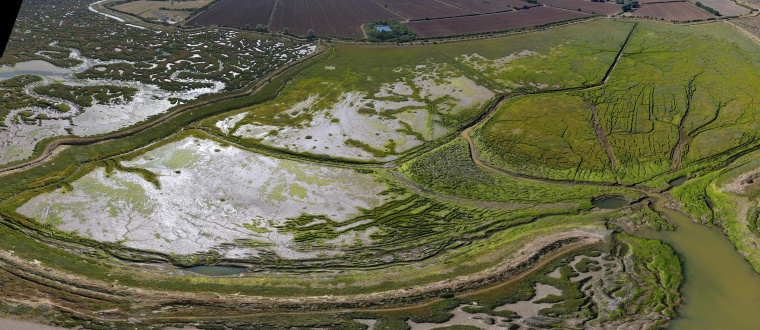
Last Friday, another key stage of the RSPB’s massive 668ha Wallasea Island Wild Coast Project was completed. For this latest stage, a newly constructed sluice was opened and tidal waters introduced to the western part of the island.
This created a new 22ha saline lagoon with a surrounding system of tidal creeks across a further 18 ha. This new saline wetland forms part of a 153 ha mosaic of terrestrial and aquatic habitats including an 18km-long network of saline, brackish and freshwater channels. These habitats are already valuable for wintering raptors (especially short-eared owls), corn bunting, reptiles and water vole.
Together these habitats comprise Phase 3 of the project. Phases 1 and 2 were completed in 2016 and involved a large-scale 165ha managed realignment (‘Jubilee Marsh’) and the creation of a 67ha regulated tidal exchange wetland (‘Pool Marsh’), so that now leaves ‘only’ around 283ha to go to compete the project!
As the RSPB crosses the half-way mark on this award-winning project, here are 10 things you might not know about Wallasea:
1. 1.5 Wembley stadium bowls could be filled with the material that was excavated from the Crossrail tunnels in London (1.65 million m³) and delivered to the island to landscape Jubilee Marsh;
2. 78 discrete islands created on the site so far (52 of these in Jubilee Marsh alone) and this includes islands within lagoons that are themselves located with much larger islands across what is the most morphologically-complex restored coastal wetland in Europe;
3. 101 breeding Avocets recorded on the island in the first year after Jubilee Marsh was created;
4. 205 tonnes of Carbon Dioxide is the equivalent amount that will already have become trapped within the Jubilee Marsh realignment site after just one year (calculations at this time derived from the natural sediment import and accretion volume which has so far been around 54,000 m³ across the lower elevation mudflat areas);
5. 783 hectares of coastal habitat that will have been be created on this island when all the work is done (668 ha for the current RSPB initiative and 115 ha for the previous ‘Allfleet’s Marsh’ project which lies next door and was created by Defra in 2006). The equates to 1,113 football pitches or an area that could cover most of central London from Kings Cross Station in the north east to the Tower of London in the south west;
6. 1,528 barge movements between London and Wallasea were needed to deliver the Crossrail tunnel excavations over a period of just 2.5 years (from August 2012 to March 2015);
7. 13,000 visitors to the island over last year as a result of the island’s habitat restoration works;
8. 1 million is the estimated number of sticklebacks within just the new Pool Marsh lagoons only 6 months after the area was opened up to tidal inundation;
9. 2.85 million (or ‘2.5 Wembley stadium bowls’) is the volume amount of material (in cubic metres) that has been imported and/or relocated on site to landscape Wallasea Island so far (this includes the 1.65 million m³ imported from Crossrail, a further 450,000m³ relocated from habitat creation excavations on the island itself and a further 550,000m³ of dredge sediment imported from Harwich that were used on the Allfleet’s Marsh site).
10. 8.5 billion marine invertebrates that, after 15 months, will have colonised the mudflat of Jubilee Marsh alone. This number is informed by field observations here and on the Allfleet’s Marsh site, colonised by more than 17,000 invertebrates/m² after the same period and will, today, be supporting an estimated further 14 billion benthic invertebrates in addition to Jubilee Marsh.
Wembley Stadium image by Jbmg40 [CC BY-SA 3.0 via Wikimedia Commons]
Wallasea Aerial courtesty RSPB
Short-eared Owl image - Ruh-red Road - 1 [CC BY 2.0]